
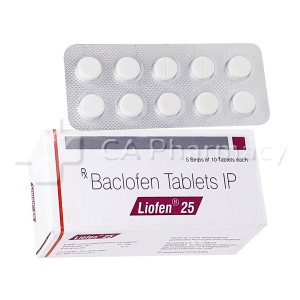
Muscle Relaxant Medications — Baclofen for Spasticity: GABA-B Mechanism, Titration Protocol, and the Withdrawal Warning Every Canadian Patient Must Know
Reviewed by Dr. Sarah Mitchell, RPh, Clinical Pharmacist, Ontario College of Pharmacists #234567 — Updated January 2026
Spasticity — the involuntary stiffness, tightness, and spasms of muscles caused by disrupted signals between the brain and spinal cord — affects an estimated 500,000 Canadians living with conditions including multiple sclerosis, spinal cord injury, cerebral palsy, and stroke. Baclofen is the most widely prescribed oral antispasmodic medication in Canada for these conditions, and one of the most clinically important medications to understand correctly: its mechanism is specific and elegant, its dosing must be carefully titrated, and its withdrawal — if abrupt — can be life-threatening. This page provides the complete clinical picture that every Canadian patient starting baclofen therapy needs.
Baclofen at a Glance
How Baclofen Works — The GABA-B Receptor Mechanism
Baclofen's mechanism is more specific than most muscle relaxants — and understanding why it targets GABA-B receptors rather than GABA-A explains both its clinical advantages and its unique withdrawal risk:
From Dr. Sarah Mitchell, RPh: A critical clinical point that many patients are not told: baclofen reduces spasticity, but some degree of muscle tone may be necessary for safe daily function. For example, a patient with MS who uses leg spasticity to help maintain balance when walking may actually become less mobile if their spasticity is over-treated. The therapeutic goal is not to eliminate all muscle tone — it is to reduce spasticity to the level that optimises function and quality of life. This is why baclofen dosing is always individualised and titrated slowly.

Dosage Titration Protocol — Baclofen by Indication
Baclofen dosing is not fixed — it requires gradual titration starting from the lowest dose and increasing every 3 days until the optimal balance of spasticity reduction and tolerability is achieved. The starting dose and titration rate differ by indication:
| Indication | Starting dose | Titration | Typical maintenance | Maximum |
|---|---|---|---|---|
| Multiple sclerosis (MS) spasticity | 5mg 3× daily | Increase by 5mg per dose every 3 days | 15–30mg 3× daily (45–80mg/day) | 80mg/day |
| Spinal cord injury spasticity | 5mg 3× daily | Increase by 5–10mg every 3 days | 20mg 3–4× daily (60–80mg/day) | 80mg/day |
| Cerebral palsy spasticity | 5mg 3× daily | Increase by 5mg every 3 days — slower titration | 15–25mg 3× daily (45–75mg/day) | 80mg/day |
| Elderly patients (≥65 years) | 5mg once or twice daily | Very slow titration — increase by 5mg every 5–7 days | Lower end of range; renal function determines dose | Renal-adjusted |
| Renal impairment (GFR <30 mL/min) | 5mg once daily or less | Extreme caution — baclofen accumulates in renal impairment | Minimum effective dose only | Physician must determine |
Baclofen is eliminated almost entirely by the kidneys (70–80% unchanged in urine). In patients with impaired renal function, baclofen accumulates — causing excessive CNS depression, confusion, and toxicity. All doses above are for adults with normal renal function. Always inform your prescribing physician about any kidney disease before starting baclofen.
The Withdrawal Warning — Why You Must Never Stop Baclofen Abruptly
This is the most important safety information for any Canadian patient taking baclofen. Abrupt discontinuation of baclofen — even after short periods of use — can cause a severe, life-threatening withdrawal syndrome:
Oral Baclofen vs Intrathecal Baclofen — Key Differences
For severe spasticity unresponsive to oral therapy, intrathecal baclofen (ITB) — delivered directly into the cerebrospinal fluid via an implanted pump — is an option. Understanding the key differences helps Canadian patients have informed conversations with their neurologists:
| Factor | Oral Baclofen | Intrathecal Baclofen (ITB) |
|---|---|---|
| Route | Tablet taken by mouth | Pump implanted surgically — delivers directly to CSF |
| Dose required | 40–80mg/day | 300–800 mcg/day — 100× lower dose |
| CNS side effects | More common — sedation, cognitive effects at higher doses | Fewer systemic effects — drug stays in CSF |
| Best for | Mild to moderate spasticity; first-line therapy | Severe spasticity unresponsive to oral therapy; patients intolerant of oral side effects |
| Withdrawal risk | High if stopped abruptly — taper required | Extreme — pump failure or catheter kink can cause life-threatening withdrawal within hours |
| Canadian coverage | Provincial drug formularies — most provinces cover | Covered in most provinces through specialist neurology programs |
| Practical consideration | Requires daily adherence; convenient; no surgery | Requires surgery, regular pump refills every 1–6 months, specialist follow-up |
Drug Interactions — What Cannot Be Combined With Baclofen
Baclofen acts on the central nervous system and significantly amplifies the effects of other CNS-depressant medications. The following combinations require extreme caution or physician supervision:
Contraindications
- Hypersensitivity to baclofen or any excipient
- Renal impairment — dose adjustment mandatory; avoid in severe renal failure (dialysis-dependent) unless under specialist supervision
- Epilepsy — baclofen lowers seizure threshold; use with caution; do not use as monotherapy for seizure control
- Psychotic disorders (schizophrenia, bipolar disorder with psychosis) — baclofen can worsen psychiatric symptoms and precipitate confusion or hallucinations
- Parkinson's disease — exacerbation of symptoms reported; use with caution
- Stroke — cerebral spasticity (post-stroke) is less responsive to oral baclofen than spinal spasticity; higher doses may be required with greater CNS side effect burden
- Pregnancy — baclofen crosses the placenta; neonatal withdrawal (tremors, stiff muscles, seizures) reported. Avoid unless clearly necessary; discuss with obstetrician
- Breastfeeding — baclofen passes into breast milk; use with caution; infant monitoring required
Frequently Asked Questions — Baclofen in Canada
How long does baclofen take to work? Some reduction in muscle spasm pain is usually noticeable within 3–4 days of starting baclofen at the initial 5mg three times daily dose. However, full therapeutic benefit — optimal spasticity control — typically requires 4–8 weeks of gradual dose titration to reach the maintenance dose. Do not judge baclofen's effectiveness at the starting dose; it almost always requires careful upward titration.
Can I take baclofen for back pain? Baclofen is specifically approved for spasticity caused by neurological conditions — multiple sclerosis, spinal cord injury, cerebral palsy, and similar conditions. It is not approved for acute musculoskeletal back pain (e.g., back strain from lifting). For acute back pain, other muscle relaxants (cyclobenzaprine, methocarbamol) are generally used. Some physicians prescribe baclofen off-label for chronic back pain with spasm — discuss with your physician whether this is appropriate for your specific situation.
Will baclofen make me drowsy? Sedation is the most common side effect — particularly in the first weeks and at higher doses. It often improves as the body adjusts. During titration, avoid driving or operating machinery until you know how each dose level affects you. Taking baclofen with food can reduce nausea but does not significantly reduce sedation. If sedation is severe, discuss dose adjustment timing (for example, taking the larger portion of the daily dose at bedtime) with your physician.
Does baclofen interact with cannabis? Yes — cannabis (THC) has significant CNS depressant properties. Combining baclofen with cannabis can substantially increase sedation, dizziness, and cognitive impairment. Many Canadian patients with MS or spinal cord injury use cannabis for pain or spasticity — if you use cannabis, inform your prescribing physician. The combination is not absolutely contraindicated but requires awareness and caution.
Can baclofen be used for alcohol dependence? There is growing evidence (particularly from European clinical trials) that high-dose baclofen reduces alcohol craving and consumption in patients with alcohol use disorder. This is an off-label use in Canada — it is not approved by Health Canada for alcohol dependence. Some Canadian addiction medicine specialists prescribe it for this indication. If you are interested in this application, discuss with an addiction medicine physician.
Do I need a prescription for baclofen in Canada? Yes. Baclofen is a prescription-only medication in Canada. It must be prescribed by a licensed Canadian physician or nurse practitioner.
How long does delivery take to my province? Standard delivery to all Canadian provinces and territories takes 4–9 business days. All orders ship in neutral packaging with no external reference to the pharmacy name or medication type.
Product in This Category
- Baclofen 10mg / 20mg Tablets — oral muscle relaxant for spasticity, MS, spinal cord injury
The content on this page is for educational purposes only and does not constitute medical or pharmacological advice. Baclofen is a prescription medication in Canada. Consult a licensed Canadian healthcare provider before starting baclofen therapy. Never stop baclofen abruptly — this can cause life-threatening withdrawal symptoms. If you experience hallucinations, seizures, or severe muscle rigidity after missing doses or stopping baclofen, call 911 or go to the nearest emergency department immediately.