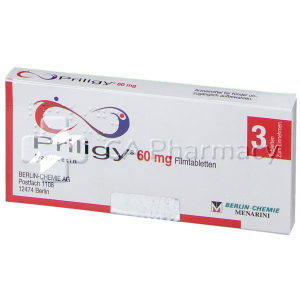

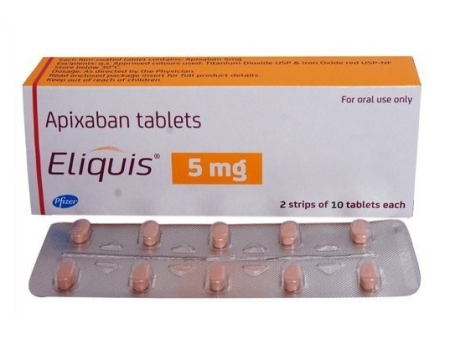

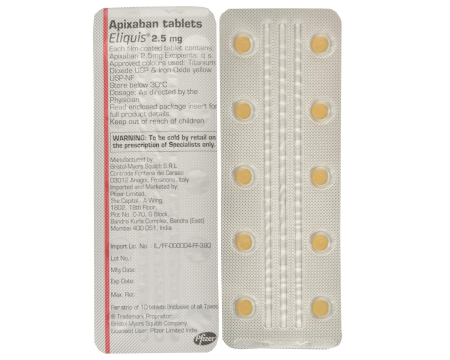
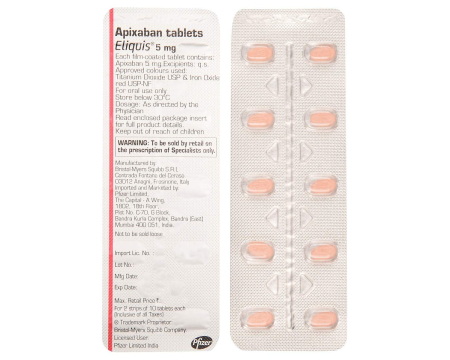


Critical — never stop apixaban without physician guidance: Premature discontinuation of apixaban significantly increases the risk of stroke and thrombotic events. The Health Canada product monograph carries a boxed warning on this point. If apixaban must be stopped for surgery or another reason, your physician will advise on bridging anticoagulation. Never stop apixaban on your own without a clinical plan.

Apixaban (Eliquis Generic) at a Glance
How Apixaban Works — Factor Xa Inhibition Mechanism
Apixaban belongs to the class of direct oral Factor Xa inhibitors. Its mechanism is highly specific — it targets a single point in the coagulation cascade, upstream of thrombin formation:
From Dr. Sarah Mitchell, RPh: A common question from Canadian patients: "If my INR is normal, does that mean my apixaban isn't working?" No — and this is a critical point. INR measures warfarin's effect on clotting factors II, VII, IX, and X. Apixaban works on Factor Xa only, and standard INR testing is insensitive to apixaban's presence. A normal INR in a patient taking apixaban tells us nothing about the drug's anticoagulant effect. This is expected and correct. No routine blood test monitoring is needed for apixaban — but annual renal function checks are recommended.

Complete Apixaban Dosing by Indication — Health Canada Product Monograph
Apixaban doses differ significantly by indication. Using the wrong dose for the wrong indication is a clinically significant error. The following table is based directly on the Health Canada product monograph for Eliquis (apixaban):
| Indication | Initial dose | Maintenance dose | Duration |
|---|---|---|---|
| Stroke prevention in non-valvular AF | — | 5mg twice daily (2.5mg twice daily if 2-of-3 renal criteria met — see below) |
Ongoing (long-term) |
| Acute DVT or PE treatment | 10mg twice daily Days 1–7 |
5mg twice daily From Day 8 onward |
Minimum 3 months; longer per clinical assessment |
| Secondary prevention of recurrent DVT/PE (after ≥6 months of treatment) |
— | 2.5mg twice daily | Long-term prevention |
| Thromboprophylaxis — knee replacement | — | 2.5mg twice daily Starting 12–24 hours post-surgery |
14 days |
| Thromboprophylaxis — hip replacement | — | 2.5mg twice daily Starting 12–24 hours post-surgery |
35 days |
Critical dosing alert — acute VTE vs AF: The initial dose for acute DVT/PE treatment is 10mg twice daily for the first 7 days — double the AF maintenance dose. Starting acute VTE treatment at the AF dose of 5mg twice daily is a clinically significant underdose that may result in inadequate anticoagulation during the highest-risk period. Conversely, continuing the 10mg twice-daily VTE initiation dose beyond Day 7 without stepping down to 5mg twice daily increases bleeding risk unnecessarily. If you are unsure which dose applies to your situation, confirm with your prescribing physician or pharmacist before taking your first dose.
The 2-of-3 Renal Dose Reduction Rule — Critical for Older Canadian Patients
Apixaban has a unique renal dose reduction system for atrial fibrillation — based on three clinical criteria rather than a simple GFR threshold. This is the most commonly misunderstood aspect of apixaban dosing in Canadian clinical practice:
| Criteria met | Correct AF dose | Clinical example |
|---|---|---|
| 0 criteria | 5mg twice daily | Age 65, weight 75kg, creatinine 90 µmol/L → standard dose |
| 1 criterion | 5mg twice daily | Age 82, weight 80kg, creatinine 95 µmol/L → only age criterion met → standard dose |
| 2 criteria | 2.5mg twice daily | Age 83, weight 55kg, creatinine 110 µmol/L → age + weight criteria met → reduced dose |
| 3 criteria | 2.5mg twice daily | Age 85, weight 52kg, creatinine 145 µmol/L → all three criteria met → reduced dose |
From Dr. Sarah Mitchell, RPh — the most common dosing error in Canadian practice: Many older Canadian patients on apixaban for AF are incorrectly dosed — some receive 2.5mg twice daily when they only meet one criterion (should be 5mg), others receive 5mg twice daily when they meet two criteria (should be 2.5mg). Underdosing in AF increases stroke risk; overdosing increases bleeding risk. Ask your physician or pharmacist at every prescription renewal to confirm that your dose has been checked against the 2-of-3 criteria using your current weight and most recent creatinine — both change over time. Note: this 2-of-3 rule applies to AF only, not to VTE treatment.
Renal Function — Additional Guidance
- CrCl >50 mL/min (normal/mild impairment): No dose adjustment needed for any indication
- CrCl 25–50 mL/min (moderate impairment): Apply 2-of-3 criteria for AF dose; standard VTE doses apply
- CrCl 15–24 mL/min (severe impairment): No dosing recommendation can be made — clinical data are very limited; specialist guidance required
- CrCl <15 mL/min or dialysis: Not recommended per Health Canada product monograph. However, published data from RENAL-AF and AXADIA-AFNET 8 trials support use in dialysis patients under specialist supervision — discuss with your nephrologist and cardiologist
The ARISTOTLE Trial — The Evidence Behind Apixaban in Atrial Fibrillation
The approval of apixaban for AF stroke prevention is based primarily on the ARISTOTLE trial — one of the largest anticoagulation trials ever conducted. Understanding what ARISTOTLE showed — and what it did not show — is essential for informed decision-making:
Important context for Canadian patients: ARISTOTLE compared apixaban to warfarin — not to other DOACs. No large randomised trial has directly compared apixaban to rivaroxaban or dabigatran head-to-head. The 2024 UBC Therapeutics Initiative conclusion that apixaban has lower major bleeding risk than rivaroxaban is based on large observational studies (27 studies, 2.1 million patients), not a randomised controlled trial. Observational data can be affected by confounders including patient selection bias. Apixaban is the preferred first-line DOAC in most Canadian guidelines, but the choice between DOACs should consider individual patient factors including dosing frequency preference, renal function, and concurrent medications.

Drug Interactions — What to Watch for with Apixaban
Apixaban is metabolised primarily by CYP3A4 and is a substrate of P-glycoprotein (P-gp). Medications that strongly affect either pathway can significantly change apixaban's plasma levels and anticoagulant effect:
Perioperative Management — Surgery and Procedures
Apixaban must be paused before elective surgery. The timing depends on the bleeding risk of the planned procedure. Per the Health Canada product monograph and Thrombosis Canada guidelines:
| Procedure bleeding risk | Stop apixaban before procedure | Examples |
|---|---|---|
| Low bleeding risk | 24 hours before | Dental cleaning, skin biopsy, cataract surgery, endoscopy without biopsy, minor dermatological procedures |
| Moderate/high bleeding risk | 48 hours before | Major abdominal surgery, joint replacement, cardiac surgery, spinal surgery, colonoscopy with biopsy, major dental extractions |
| Renal impairment (CrCl 15–50 mL/min) |
72 hours before (high risk procedures) |
Prolonged elimination in renal impairment requires longer pause — discuss with surgeon and pharmacist |
Bridging anticoagulation: Bridging with heparin or LMWH is generally not required when stopping apixaban for elective procedures, per current Thrombosis Canada guidance — apixaban's relatively short half-life means adequate elimination is achieved within 24–48 hours in patients with normal renal function. Restart apixaban 24–48 hours after the procedure, once haemostasis is confirmed.
Reversal of Apixaban — Andexanet Alfa (Ondexxya)
For life-threatening or uncontrolled bleeding in patients taking apixaban, a specific reversal agent is available in Canada:
Andexanet alfa (Ondexxya) — approved by Health Canada for reversal of apixaban and rivaroxaban anticoagulation in life-threatening or uncontrolled bleeding. Available in Canadian hospital emergency departments. Mechanism: andexanet alfa is a modified inactive form of Factor Xa that acts as a decoy receptor, binding and sequestering apixaban molecules and rapidly restoring Factor Xa activity.
For non-life-threatening bleeding: supportive measures, activated charcoal if <2 hours post-dose (reduces apixaban AUC by ~50%), local haemostasis. Protamine sulfate and Vitamin K have no effect on apixaban activity.
Contraindications
- Clinically significant active bleeding
- Mechanical prosthetic heart valves — absolute contraindication; warfarin only
- Significant hepatic impairment (Child-Pugh Class C) — contraindicated
- CrCl <15 mL/min or dialysis — not recommended (see renal section above)
- Hypersensitivity to apixaban or any excipient
- Lesion or condition at significant risk of major bleeding (active GI ulcer, recent intracranial haemorrhage)
- Antiphospholipid syndrome (APS) with triple-positive antibody profile — warfarin preferred over any DOAC
- Pregnancy — avoid; limited safety data; use LMWH in pregnancy requiring anticoagulation
Frequently Asked Questions — Apixaban in Canada
Does it matter what time of day I take apixaban? Yes — consistency matters more than the specific time. Choose two times approximately 12 hours apart (for example, 8am and 8pm) and take your doses at the same times every day. This maintains steady-state plasma levels without large peaks and troughs. Apixaban can be taken with or without food — no meal timing requirement (unlike rivaroxaban).
What if I miss a dose? Take the missed dose as soon as you remember on the same day. If you do not remember until the following day, skip the missed dose and resume your normal schedule — never double up. Never take two doses in one day to compensate for a missed dose. If you regularly forget doses, discuss strategies with your pharmacist — pill organisers, phone reminders, or blister packs can help.
Can I take apixaban with blood pressure medications? Most blood pressure medications (ACE inhibitors, ARBs, beta-blockers, calcium channel blockers) have no significant interaction with apixaban. However, some calcium channel blockers — particularly diltiazem and verapamil — inhibit both CYP3A4 and P-gp and can increase apixaban plasma levels modestly. This combination is not contraindicated but warrants awareness, particularly in patients at elevated bleeding risk.
Will cannabis affect my apixaban? Cannabis (THC/CBD) can inhibit CYP3A4, potentially increasing apixaban plasma levels — though the clinical significance in most patients is modest. More relevant is that cannabis and apixaban both increase bleeding tendency through separate mechanisms. If you use cannabis regularly, inform your physician and pharmacist — they can assess your individual risk.
Is generic apixaban as effective as Eliquis? Yes. Generic apixaban received Health Canada approval in 2023 and is bioequivalent to branded Eliquis — it contains the same active ingredient at the same dose and meets the same pharmaceutical standards. The 75% cost reduction makes generic apixaban significantly more affordable for Canadian patients, with no difference in clinical efficacy or safety.
Do I need to tell my dentist I take apixaban? Yes — always inform any healthcare provider, including your dentist, that you take an anticoagulant. For routine dental cleaning, apixaban does not typically need to be stopped. For tooth extractions or oral surgery, your dentist and prescribing physician should coordinate on whether to pause apixaban and for how long. Most dental extractions in patients on apixaban can be managed with local haemostatic measures without stopping the medication.
How long does delivery take to my province? Standard delivery to all Canadian provinces and territories takes 4–9 business days. All orders ship in neutral packaging with no external reference to the pharmacy name or medication type.
Related Products and Category
- Xarelto Generic (Rivaroxaban) — once-daily Factor Xa inhibitor; must be taken with evening meal
- Anticoagulants Category — complete guide to all 5 Canadian anticoagulants, warfarin vs DOAC comparison, switching protocol
The content on this page is for educational purposes only and does not constitute medical or pharmacological advice. Apixaban is a prescription medication in Canada requiring a valid prescription from a licensed Canadian physician or healthcare provider. Never start, stop, or change your apixaban dose without physician guidance — premature discontinuation significantly increases stroke risk. If you experience signs of serious bleeding — blood in urine or stool, coughing blood, sudden severe headache — call 911 or go to the nearest emergency department immediately. Patients with mechanical heart valves must not take apixaban.