
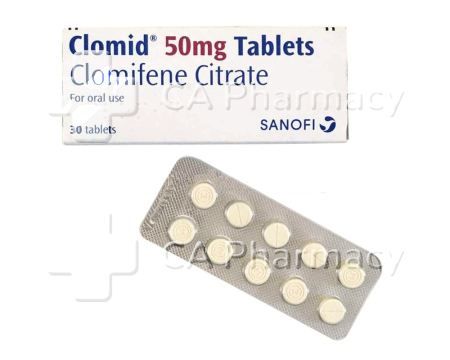


Note for Canadian patients: Brand-name Clomid (Sanofi-Aventis Canada Inc.) is no longer manufactured for the Canadian market. Generic clomiphene citrate 50mg remains fully available through licensed pharmacies and is therapeutically identical — same active molecule, same dosage form, same clinical efficacy, as required by Health Canada bioequivalence standards.

Clomid at a Glance — Four Numbers Canadian Patients Need to Know
How Clomiphene Citrate Works — The SERM Mechanism Step by Step
Most pharmacy websites describe Clomid as something that simply "stimulates the ovaries." This is incomplete. As a SERM, clomiphene's action begins in the brain — not the ovaries — and understanding the full pathway helps set realistic expectations:
Clomid Success Rates by Cycle — What the Evidence Actually Shows
The headline figures — 80% ovulation, 40% pregnancy — are accurate but can be misleading without the cycle-by-cycle context:
| Treatment cycle | Ovulation rate | Per-cycle pregnancy rate | Clinical context |
|---|---|---|---|
| Cycle 1 — 50mg | ~60% | 5–10% | Starting dose. If no ovulation on Day 21 progesterone test, dose increases next cycle. |
| Cycle 2 — 50–100mg | ~75% | 10–15% | Most successful ovulations occur in cycles 1–3. IUI can be added to improve per-cycle rates. |
| Cycle 3 — 100mg | ~80% | 10–15% | Peak ovulation response. If no pregnancy by cycle 3, your doctor may recommend IUI, switching to letrozole, or additional investigations. |
| Cycles 4–6 — 100mg | 80% (plateau) | 5–8% per cycle | Diminishing per-cycle returns. Cumulative pregnancy rate approaches 40% across all 6 cycles. |
| After 6 cycles | STOP | — | SOGC guidelines: discontinue. Prolonged clomiphene use is associated with long-term ovarian cancer risk. Discuss letrozole, gonadotropins, or IVF with your specialist. |
From Dr. Sarah Mitchell, RPh: Clomid is an ovulation trigger, not a pregnancy guarantee. It resolves the ovulatory barrier — but if other factors are also contributing (tubal blockage, male factor, endometriosis, egg quality), ovulation alone may not be sufficient. A complete fertility workup for both partners is essential before starting treatment.

Who Benefits from Clomid — and Who Is Unlikely to Respond
Clomid vs Letrozole (Femara) — What Canadian Fertility Specialists Discuss
| Parameter | Clomid (Clomiphene) | Letrozole (Femara) |
|---|---|---|
| Mechanism | SERM — blocks hypothalamic estrogen receptors | Aromatase inhibitor — temporarily reduces estrogen synthesis |
| Pregnancy rate (PCOS) | 15–20% | 29–36% (significantly higher — Cochrane 2016) |
| Live birth rate (PCOS) | 10–11% | 25–36% (significantly higher) |
| Endometrial lining | Can thin (anti-estrogenic effect) | No adverse effect — improves receptivity |
| Cervical mucus | Can thicken — impairs sperm transport | No adverse effect |
| Multiple pregnancy risk | 5–10% | Lower — favours monofollicular development |
| Health Canada status | Approved for ovulation induction | Off-label for fertility (approved for breast cancer) — widely used in Canadian clinical practice |
| Best suited for | Non-PCOS anovulation; unexplained infertility + IUI | PCOS-related anovulation — preferred by updated SOGC guidance |
Clinical note from Dr. Sarah Mitchell, RPh: If you have PCOS and are being offered Clomid as first-line treatment, it is reasonable to ask your doctor specifically about letrozole. Multiple large RCTs — including the PPCOS II study and the 2016 Cochrane systematic review — show letrozole produces significantly higher live birth rates in PCOS patients. Clomid remains appropriate for non-PCOS ovulatory dysfunction and as a well-studied option in IUI protocols for unexplained infertility.
Dosage and Treatment Protocol — Canadian Clinical Guidelines (SOGC)
Side Effects — What to Expect and When to Stop Immediately
Common (>10% of users)
- Hot flashes / vasomotor flushing
- Bloating or pelvic discomfort
- Mood changes / irritability
- Breast tenderness
- Nausea (usually mild)
- Headache
Less common
- Visual disturbances (blurred vision, spots, flashes)
- Ovarian enlargement
- Thick cervical mucus / vaginal dryness
- Abnormal uterine bleeding
- Ovarian cyst formation
Stop immediately — seek medical care
- Any visual symptoms — may be irreversible; discontinue and see your doctor immediately
- Severe pelvic pain / abdominal distension (OHSS)
- Sudden weight gain with bloating (OHSS)
- Shortness of breath (severe OHSS)
- Allergic reaction (rash, swelling, breathing difficulty)
Contraindications
- Hypersensitivity to clomiphene citrate or any tablet component
- Pregnancy — pregnancy test required before each cycle; Clomid carries fetal risk
- Liver disease or impaired hepatic function
- Hormone-dependent tumours (estrogen- or progesterone-receptor positive)
- Ovarian cysts or enlargement not caused by PCOS
- Abnormal uterine bleeding of undetermined cause
- Primary pituitary or ovarian failure
- Uncontrolled thyroid or adrenal dysfunction
Frequently Asked Questions — Clomid in Canada
Can I get Clomid without a prescription in Canada? No. Clomiphene citrate is a Schedule I prescription-only medication under Canada's Food and Drugs Act. A valid prescription from a licensed Canadian physician is required. Most patients obtain one after baseline bloodwork (Day 3 FSH, LH, AMH, estradiol) and a pelvic ultrasound to confirm ovarian reserve and exclude structural issues.
Is generic clomiphene identical to brand-name Clomid? Yes — therapeutically. Both contain 50mg clomiphene citrate USP with the same non-medicinal ingredients (cornstarch, lactose monohydrate, magnesium stearate, pregelatinized starch, sucrose). Health Canada requires demonstrated bioequivalence — the same rate and extent of absorption — before approving any generic.
Why is brand-name Clomid no longer available in Canada? Sanofi-Aventis Canada Inc. discontinued Canadian manufacturing of brand-name Clomid. This is a commercial decision — not a safety issue. Generic clomiphene citrate 50mg remains available through licensed pharmacies under the same Health Canada regulatory standards.
Can Clomid be used for male infertility? Yes — off-label. Some Canadian fertility specialists prescribe clomiphene at lower doses (25mg daily or every other day) to men with low testosterone or oligospermia. By blocking hypothalamic estrogen receptors in men, Clomid increases LH and FSH, stimulating testosterone and sperm production. This use is not an approved Health Canada indication but is recognized clinical practice.
Is it safe to drive while taking Clomid? Use caution. Clomid can cause visual disturbances in some patients. Health Canada recommends avoiding driving, operating machinery, or activities requiring clear vision until you know how the medication affects you specifically.
What is the difference between Clomid and Serophene? None — both are brand names for clomiphene citrate 50mg. Serophene was also discontinued in Canada. Both have been replaced by generic clomiphene citrate, which is therapeutically equivalent.

Related Products
- Nolvadex (Tamoxifen) — another SERM with some off-label use in ovulation induction, particularly in clomiphene-resistant cases
The content on this page is for educational purposes only and does not constitute medical or pharmacological advice. Clomiphene citrate is a prescription medication in Canada requiring physician supervision. Fertility treatment protocols must be individualised by a licensed healthcare provider — timing, monitoring, dose adjustments and cycle management are essential components of safe and effective therapy. Never use prescription fertility medications without proper medical oversight.