
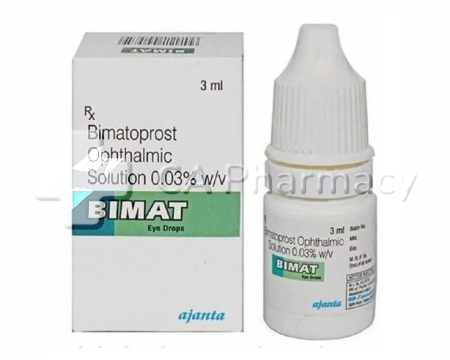


Bimat is manufactured by Ajanta Pharma — the same GMP-certified Indian manufacturer behind the Kamagra range — and contains the identical active ingredient as Allergan's brand-name Lumigan (glaucoma) and Latisse (eyelash growth), at a fraction of the cost.

Bimatoprost at a Glance
How Bimatoprost Works — Two Mechanisms, One Molecule
This is what most competitor pages miss: bimatoprost does not work the same way for glaucoma as it does for eyelash growth. These are two distinct pharmacological mechanisms in the same molecule:
Why this matters clinically: The eyelash growth effect of bimatoprost was discovered accidentally — glaucoma patients using Lumigan eye drops reported noticeably longer, darker lashes as a side effect. Allergan subsequently ran clinical trials and received FDA approval in 2008 for bimatoprost as Latisse specifically for eyelash hypotrichosis. The two uses are pharmacologically linked but mechanistically distinct. Bimat delivers the same molecule as both Lumigan and Latisse.
Bimat vs Careprost vs Latisse — Same Molecule, Very Different Prices
All three products contain bimatoprost 0.03% in a 3ml ophthalmic solution. The differences are manufacturer, price, and regulatory history in Canada:
| Product | Active ingredient | Manufacturer | Concentration | Approx. price (3ml) | Notes |
|---|---|---|---|---|---|
| Bimat (with brush) | Bimatoprost 0.03% | Ajanta Pharma | 0.03% | ~$45–55 CAD | Includes sterile brush applicator. GMP certified. |
| Careprost | Bimatoprost 0.03% | Sun Pharma | 0.03% | ~$40–55 CAD | Most widely known generic. Brush sometimes sold separately. |
| Lumigan (Allergan) | Bimatoprost 0.03% | Allergan / AbbVie | 0.03% | ~$100–130 CAD | Brand-name, Health Canada approved for glaucoma. Requires prescription. |
| Latisse (Allergan) | Bimatoprost 0.03% | Allergan / AbbVie | 0.03% | ~$150–220 CAD | FDA & Health Canada approved for eyelash hypotrichosis. Comes with sterile applicators. Highest price point. |
From Dr. Sarah Mitchell, RPh: Bimat and Careprost contain the identical active molecule as Latisse and Lumigan. The therapeutic effect is the same. The price difference reflects brand development costs, regulatory approval fees, and marketing — not a difference in the bimatoprost molecule itself. From a pharmacist's perspective, if you are using bimatoprost for eyelash cosmetic purposes, the generic products deliver the same result at a fraction of the cost.

How to Apply Bimat — Step-by-Step Protocol for Eyelash Growth
Application technique matters — incorrect use reduces results and increases the risk of unwanted hair growth on surrounding skin:
Maintenance after 16 weeks: Once desired lash length is achieved, reduce application to once weekly to maintain results. If you stop using Bimat completely, eyelashes gradually return to their original appearance within weeks to months. This is because bimatoprost extends the growth phase — it does not permanently change the follicle. Consistent maintenance use is required to sustain results.
How to Use Bimat for Glaucoma / Ocular Hypertension
Side Effects — The Honest Profile Including the Ones Other Sites Downplay
Common — usually mild
- Eye redness / conjunctival hyperemia
- Eye itching or irritation
- Dry eyes
- Burning or stinging on application
- Foreign body sensation
- Darkening of eyelid skin (usually reversible)
Less common
- Unwanted hair growth on skin where solution contacts regularly
- Headache
- Blurred vision (temporary)
- Eyelash changes — may grow in new directions
- Sunken appearance of eyes (orbital fat changes — rare, associated with long-term glaucoma use)
Permanent risk — iris pigmentation
This is the side effect most competitors underplay. Bimatoprost — particularly when used as an eye drop for glaucoma — can permanently increase the amount of brown pigment in the iris (the coloured part of the eye). Blue, green, or hazel eyes may gradually become more brown. This change is irreversible. It does not affect vision, but it is permanent. The risk is substantially lower when bimatoprost is applied only to the lash line (not instilled directly into the eye), but patients should be aware of it.
Clinical note from Dr. Sarah Mitchell, RPh: Iris colour change is the most clinically significant long-term side effect of bimatoprost. For cosmetic eyelash use, it occurs far less frequently than with glaucoma eye drop use — because the solution is applied to the skin rather than instilled into the eye. However, it is not zero risk, particularly if solution regularly enters the eye. Patients with green or hazel eyes considering long-term cosmetic use should discuss this risk explicitly with their doctor or pharmacist.
Contraindications and Precautions
- Hypersensitivity or allergy to bimatoprost or benzalkonium chloride (the preservative)
- Active eye infection or inflammation (uveitis, conjunctivitis) — treat first, then consider bimatoprost
- Macular edema or history of iritis — bimatoprost may worsen macular edema
- Contact lenses — must be removed for each application (reinsert after 15 minutes)
- Recent eye surgery — consult your surgeon before starting bimatoprost
- Pregnancy and breastfeeding — safety has not been established; consult your doctor
- Children under 16 — not recommended; insufficient safety data on long-term pigmentation effects in paediatric patients
- Concurrent prostaglandin analog eye drops — do not use more than one prostaglandin analog simultaneously; additive pigmentation risk without additive IOP benefit
Frequently Asked Questions — Bimat in Canada
Is Bimat the same as Careprost and Latisse? All three contain bimatoprost 0.03% in a 3ml ophthalmic solution — the same active molecule. Bimat is manufactured by Ajanta Pharma, Careprost by Sun Pharma, and Latisse by Allergan (AbbVie). The therapeutic effect is identical. Latisse carries Health Canada approval specifically for eyelash hypotrichosis and FDA approval; Bimat and Careprost are generic equivalents at substantially lower cost.
Can I use Bimat if I have naturally dark eyes? Yes, and the iris pigmentation risk is essentially irrelevant for patients who already have dark brown eyes — there is no lighter-coloured iris to darken further. For cosmetic lash use, patients with any iris colour can use Bimat on the lash line with a significantly reduced pigmentation risk compared to direct eye drop instillation.
What happens if I stop using Bimat for eyelashes? Lashes gradually return to their original appearance — typically within a few weeks to a few months after stopping. Bimatoprost extends the growth phase; it does not permanently reprogram hair follicles. Once you stop, follicles return to their natural cycle. To maintain results, switch to once-weekly maintenance application rather than stopping completely.
Can Bimat be used for eyebrow growth? It is used off-label for this purpose by some patients, and the mechanism — prolonging the anagen phase of hair follicles — is the same. However, it is not approved for eyebrow use, and the facial skin around eyebrows is more prone to unwanted hair growth and skin pigmentation changes. Use with caution and discuss with your doctor.
Do I need a prescription for Bimat in Canada? Bimatoprost is classified as a prescription medication in Canada. Your doctor or optometrist can prescribe it for either glaucoma or eyelash hypotrichosis. Many patients obtain it through licensed online pharmacies with a valid Canadian prescription.
How should I store Bimat? Store at room temperature (15–25°C), away from light and moisture. Do not freeze. Once opened, use within 4 weeks — discard any remaining solution after this period as sterility cannot be guaranteed. Keep out of reach of children.

Related Products
- Careprost (Bimatoprost 0.03%) — Sun Pharma alternative with same active ingredient
- Lumigan (Bimatoprost) — Allergan brand-name for glaucoma
The content on this page is for educational purposes only and does not constitute medical or pharmacological advice. Bimatoprost is a prescription medication in Canada. Use only as directed by a licensed Canadian healthcare provider. For glaucoma, do not discontinue this or any other IOP-lowering medication without your ophthalmologist's guidance — uncontrolled intraocular pressure can lead to permanent vision loss.