


Medically reviewed by Dr. Sarah Mitchell, RPh, Clinical Pharmacist — Updated April 2026
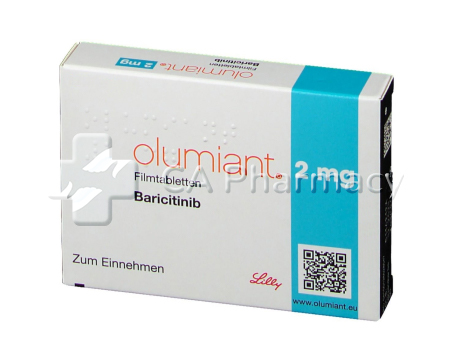
What Is Baricitinib (Olumiant)? — Complete JAK Inhibitor Mechanism
Baricitinib is a selective, reversible inhibitor of Janus kinase 1 (JAK1) and Janus kinase 2 (JAK2) — two members of the JAK family of intracellular tyrosine kinases. Understanding the JAK-STAT pathway explains how baricitinib exerts its anti-inflammatory effects across multiple disease indications:
The JAK-STAT signalling pathway — why it matters in inflammatory disease: Many pro-inflammatory cytokines (signalling proteins that drive inflammation) transmit their effects through receptors on the cell surface that are coupled to JAK enzymes. When a cytokine binds its receptor, the associated JAK enzymes are activated — they phosphorylate and activate downstream signal transducers and activators of transcription (STAT proteins). Activated STATs translocate to the cell nucleus and drive the transcription of pro-inflammatory genes — producing more cytokines, activating immune effector cells, and perpetuating the inflammatory cascade. In rheumatoid arthritis, atopic dermatitis, alopecia areata, and COVID-19 hyperinflammation, dysregulated JAK-STAT signalling drives the pathological immune response that causes tissue damage and symptoms.
Baricitinib's targeted inhibition: Baricitinib selectively inhibits JAK1 and JAK2, blocking the intracellular signalling of multiple disease-relevant cytokines simultaneously. Key cytokines blocked by baricitinib's JAK1/JAK2 inhibition include: interleukin-6 (IL-6 — central driver of RA systemic inflammation and COVID-19 cytokine storm), interleukin-4 and interleukin-13 (IL-4/IL-13 — key drivers of atopic dermatitis Th2 inflammation), interleukin-2 (IL-2 — T-cell proliferation and survival), interferon-gamma (IFN-γ — macrophage activation and alopecia areata pathogenesis), granulocyte-macrophage colony-stimulating factor (GM-CSF — myeloid cell activation), and erythropoietin (EPO — red blood cell production, via JAK2). This broad cytokine blockade through a single oral once-daily tablet represents a distinct advantage over biological DMARDs that each target only one cytokine.
Why JAK inhibitors differ from biological DMARDs (biologics):
- Baricitinib is an oral small molecule — no injections or infusions required
- Broad intracellular cytokine blockade vs. single-target biologics (adalimumab blocks TNF-α only; tocilizumab blocks IL-6 only)
- Rapid onset of effect — clinical response often apparent within 2 to 4 weeks, faster than many biologics
- No immunogenicity (anti-drug antibody formation) — a common cause of biologic treatment failure over time
- No requirement for refrigerated storage or specialist administration
Health Canada-Approved Indications
1. Moderate-to-Severe Rheumatoid Arthritis (RA) — Primary Indication
Rheumatoid arthritis is a chronic systemic autoimmune disease affecting approximately 300,000 Canadians — predominantly women (3:1 female-to-male ratio), typically onset between 30 and 60 years of age. The hallmark of RA is synovial inflammation driven by dysregulated immune responses — producing the progressive joint destruction, pain, stiffness, and functional impairment that significantly reduce quality of life. JAK-STAT signalling (particularly JAK1/JAK2-mediated IL-6 and IFN-γ pathways) is central to the perpetuation of synovial inflammation in RA.
Health Canada approved baricitinib for adults with moderate-to-severe RA who have had an inadequate response or intolerance to methotrexate. Baricitinib can be used as monotherapy or in combination with methotrexate.
Clinical trial evidence (RA-BEAM, RA-BUILD, RA-BEACON trials):
- RA-BEAM trial: Baricitinib 4mg demonstrated superiority over adalimumab (Humira) — the most commonly prescribed biologic DMARD — in achieving ACR20 response at 12 weeks (70% vs 61%), with numerically higher ACR50 and ACR70 response rates
- Statistically significant improvements in physical function (HAQ-DI), pain scores, fatigue, and radiographic joint damage progression inhibition
- Rapid onset: statistically significant improvement in signs and symptoms observed as early as week 1 in some trials
- Maintenance of response: sustained efficacy demonstrated through 104 weeks (2 years) of continuous treatment
Canadian position in RA treatment pathway (per ACR/EULAR guidelines adapted for Canadian practice):
- First-line: conventional synthetic DMARDs (methotrexate — the anchor DMARD)
- Second-line (inadequate response to methotrexate): biological DMARDs (TNF inhibitors: adalimumab, etanercept, certolizumab; IL-6 inhibitors: tocilizumab, sarilumab) OR JAK inhibitors (baricitinib, upadacitinib, tofacitinib) — selection based on patient profile, comorbidities, and risk assessment
- Third-line (failure of first biologic or JAK inhibitor): switch within class or to another DMARD class
2. Moderate-to-Severe Atopic Dermatitis (Eczema)
Atopic dermatitis (AD) is a chronic, relapsing inflammatory skin disease characterised by intense pruritus (itch), eczematous skin lesions, and impaired skin barrier function. It affects up to 17% of Canadian children and 10% of Canadian adults — making it the most common inflammatory skin condition in Canada. Severe AD causes substantial quality of life impairment, including sleep disruption, anxiety, depression, and significant social impact.
The pathophysiology of AD involves Th2-polarised immune dysregulation — with IL-4 and IL-13 (both signalling through JAK1) playing central roles in driving IgE production, eosinophil recruitment, and epidermal barrier disruption. Baricitinib's JAK1 inhibition targets this core Th2 inflammatory mechanism.
Health Canada approved baricitinib for adults and adolescents (12 years and older) with moderate-to-severe atopic dermatitis inadequately controlled with topical therapies. Baricitinib is used in combination with topical corticosteroids.
Clinical evidence (BREEZE-AD trials):
- BREEZE-AD7: Baricitinib 4mg + topical corticosteroids — 31% of patients achieved IGA 0/1 (clear or almost clear skin) vs 19% with placebo at week 16
- Significant reduction in pruritus (itch) — a primary driver of AD quality of life impairment — observed as early as day 2 to 3 in some patients
- Significant improvements in sleep quality, anxiety, and depression measures
- Well-tolerated in the AD population with a safety profile consistent with RA trials
3. Severe Alopecia Areata
Alopecia areata (AA) is an autoimmune hair loss condition affecting approximately 2% of Canadians at some point in their lifetime — caused by T-cell-mediated attack on hair follicles. It can range from patchy scalp hair loss to complete scalp baldness (alopecia totalis) and complete body hair loss (alopecia universalis). Until the approval of JAK inhibitors, no disease-modifying pharmacotherapy existed for severe AA — treatment was largely limited to immunosuppression with variable, often temporary results.
IFN-γ and IL-15, both signalling through JAK1/JAK2, are central to the T-cell attack on hair follicles in alopecia areata. Baricitinib's JAK1/JAK2 inhibition restores immune privilege to the hair follicle, allowing hair regrowth.
Clinical evidence (BRAVE-AA1 and BRAVE-AA2 trials):
- BRAVE-AA1: Baricitinib 4mg — 38.8% of patients achieved a SALT (Scalp Hair Assessment Tool) score ≤20 (at least 80% scalp hair coverage) at week 36, compared to 6.2% with placebo — a clinically remarkable result for a condition previously considered pharmacologically intractable
- Baricitinib 2mg: 22.8% SALT ≤20 at week 36 vs 6.2% placebo
- Health Canada approved baricitinib as the first JAK inhibitor for alopecia areata in Canada, representing a major advance for Canadian patients with severe hair loss
4. Hospitalised COVID-19 — Approved for Hospital Use Only
Health Canada has authorised baricitinib for hospitalised COVID-19 adults requiring supplemental oxygen or mechanical/non-invasive ventilation. This is a hospital-administered indication — baricitinib for COVID-19 is not used in outpatient or mild COVID-19 settings.
The rationale: severe COVID-19 is characterised by a dysregulated hyperinflammatory response (cytokine storm) — involving IL-6, IFN-γ, GM-CSF, and other JAK-STAT-dependent cytokines — that drives the acute respiratory distress and multi-organ failure causing COVID-19 deaths. Baricitinib's JAK1/JAK2 inhibition attenuates this hyperinflammation while preserving anti-viral immunity.
The ACTT-2 trial (NIAID, 1,033 patients): baricitinib + remdesivir significantly reduced time to recovery compared to remdesivir alone (7 vs 8 days), with greater benefit in patients requiring high-flow oxygen or non-invasive ventilation. The COV-BARRIER trial (1,525 patients): baricitinib + standard of care (including dexamethasone) reduced 28-day mortality by 38% compared to placebo — a clinically and statistically significant result.
Baricitinib vs Other JAK Inhibitors — The Canadian Comparison
Canadian rheumatologists and dermatologists choose between three Health Canada-approved JAK inhibitors for RA and related conditions. This is the most frequent comparison in Canadian specialist practice:
| Baricitinib (Olumiant) | Upadacitinib (Rinvoq) | Tofacitinib (Xeljanz) | |
|---|---|---|---|
| JAK selectivity | JAK1 + JAK2 | JAK1 selective (highest selectivity) | JAK1 + JAK3 |
| RA doses | 2mg or 4mg once daily | 15mg once daily | 5mg twice daily (or 11mg XR once daily) |
| Dosing frequency | Once daily | Once daily | Twice daily (standard) or once daily (XR) |
| RA indication | Yes | Yes | Yes |
| Atopic dermatitis indication | Yes | Yes | No (not approved for AD in Canada) |
| Alopecia areata indication | Yes | No | No |
| COVID-19 (hospitalised) indication | Yes | No | No |
| Head-to-head vs adalimumab (Humira) | Shown non-inferior/superior in RA-BEAM | Shown superior in SELECT-COMPARE | Not directly compared |
| Renal clearance predominant | Yes — dose reduction needed in renal impairment | No (hepatic) | Partial renal |
| Canadian CADTH reimbursement (RA) | Yes — provincial formularies | Yes — provincial formularies | Yes — provincial formularies |
Health Canada Black Box Warning — Critical Safety Information
Health Canada requires baricitinib (and all JAK inhibitors) to carry prominent Black Box warnings — the most serious safety warnings in Canadian drug labelling. All Canadian patients and prescribers must be aware of these risks before starting baricitinib:
1. Serious Infections: Baricitinib's immunosuppressive mechanism increases susceptibility to serious bacterial, fungal, viral, and opportunistic infections — including tuberculosis (TB), invasive fungal infections (aspergillosis, candidiasis, pneumocystis), bacterial pneumonia, and viral infections. Fatal infections have been reported. Before starting baricitinib, all patients must be screened for latent tuberculosis (tuberculin skin test or IGRA blood test — standard Canadian practice before all immunosuppressive therapies). If latent TB is detected, TB prophylaxis (isoniazid) must be completed before starting baricitinib. Patients with active serious infections should not start baricitinib. Report any signs of infection (fever, chills, productive cough, burning with urination) to a physician promptly.
2. Malignancy (Cancer): Immunosuppressive therapies carry an increased risk of malignancy. Lymphoma and other malignancies have been reported in baricitinib-treated patients. The risk of non-melanoma skin cancer (basal cell carcinoma, squamous cell carcinoma) is increased — Canadian patients on baricitinib should use broad-spectrum sunscreen and practice regular skin self-examination; annual dermatological screening is recommended for long-term users. The overall malignancy risk versus benefits must be considered for each individual patient with their Canadian rheumatologist.
3. Major Adverse Cardiovascular Events (MACE): An increased risk of major cardiovascular events — including myocardial infarction (heart attack) and stroke — has been identified with JAK inhibitor use in RA patients, particularly in a post-marketing safety study (ORAL Surveillance) comparing tofacitinib to TNF inhibitors in patients aged 50+ with at least one cardiovascular risk factor. While baricitinib was not studied in ORAL Surveillance, Health Canada has applied precautionary labelling to all JAK inhibitors based on the class-level concern. Baricitinib should be used with caution in Canadian patients with known cardiovascular disease or multiple cardiovascular risk factors. The risk-benefit discussion with a Canadian rheumatologist or cardiologist is essential before starting baricitinib in high-risk patients.
4. Thrombosis (Blood Clots) — Venous Thromboembolism (VTE): Deep vein thrombosis (DVT) and pulmonary embolism (PE) have been reported with baricitinib — at higher rates in patients with known risk factors for VTE, particularly at the 4mg dose. The mechanism relates to JAK2 inhibition affecting erythropoietin signalling and platelet/coagulation pathways. Canadian patients with prior VTE, inherited thrombophilia, immobility, obesity, or who are post-surgical require careful risk assessment before baricitinib initiation. If symptoms of DVT (leg swelling, pain, redness) or PE (sudden shortness of breath, chest pain) develop — seek emergency medical care immediately.
5. Mortality: In older adults (age 65+) who are current or former smokers with at least one cardiovascular risk factor, all-cause mortality was increased with tofacitinib compared to TNF inhibitors in the ORAL Surveillance trial. Similar precautionary messaging applies to baricitinib in this patient population.
Canadian Dosing Guide
Rheumatoid Arthritis:
- Recommended starting dose: 2mg once daily
- Dose escalation: if inadequate response, increase to 4mg once daily
- Patients aged 75 years and older: 2mg once daily recommended (lower risk profile)
- Once daily administration — with or without food; at the same time each day
Atopic Dermatitis:
- Adults: 2mg or 4mg once daily; use the lowest effective dose
- Adolescents (12–17 years): 2mg once daily (4mg if inadequate response); weight ≥30kg required
- Used in combination with topical corticosteroids
Alopecia Areata:
- Adults: 2mg once daily; increase to 4mg once daily if response is inadequate after 6 months
- Assessment of hair regrowth response: evaluate at 6 months; discontinue if no significant response by 6 months at 4mg
Dose reductions required in:
- Moderate renal impairment (eGFR 30–60 mL/min/1.73m²): maximum 2mg once daily
- Severe renal impairment (eGFR <30): not recommended
- Concomitant use of strong OAT3 inhibitors (probenecid): reduce dose by half
Monitoring required during treatment:
- CBC (complete blood count) — lymphocyte count, neutrophil count, haemoglobin at baseline and periodically
- Lipid panel — at 12 weeks after starting and periodically thereafter (baricitinib increases LDL and HDL cholesterol)
- Liver function tests — baseline and as clinically indicated
- Renal function — baseline and periodically
- Tuberculosis screening — mandatory before starting
- Skin cancer surveillance — annual dermatological assessment for long-term users

Side Effects — Complete Canadian Guide
Very common (>10% of patients):
- Upper respiratory tract infections: Nasopharyngitis, sinusitis, pharyngitis — the most frequently reported infections in baricitinib trials. Usually mild to moderate in severity. Report any respiratory infection that is severe, prolonged, or accompanied by high fever to your physician
- Increased cholesterol (hyperlipidaemia): Both LDL ("bad") and HDL ("good") cholesterol increase with baricitinib. Lipid levels typically increase within the first 12 weeks and then stabilise. Canadian patients with pre-existing dyslipidaemia or cardiovascular risk factors should discuss lipid management with their physician — statin therapy initiation or adjustment may be warranted
Common (1–10% of patients):
- Urinary tract infections (UTI) — increased susceptibility due to immunosuppression; report dysuria, frequency, or fever to a physician
- Herpes zoster (shingles) — JAK inhibitors increase reactivation risk of varicella-zoster virus. Vaccination against herpes zoster (Shingrix — the recombinant zoster vaccine) is recommended before starting baricitinib if possible; Shingrix is a non-live vaccine safe in immunocompromised patients and is available at most Canadian pharmacies
- Nausea — usually mild and transient; taking with food helps
- Headache — usually self-limiting
- Herpes simplex (cold sores, genital herpes) reactivation — report to physician; oral antiviral suppressive therapy may be indicated
- Acne — particularly relevant in the atopic dermatitis and alopecia areata populations where younger patients are treated
- Elevated liver enzymes (ALT, AST) — usually mild and transient; severe elevations requiring dose interruption are rare
- Thrombocytosis (elevated platelet count) — clinically significant in terms of thrombosis risk; monitor
Serious — requiring immediate medical attention:
- Serious infections (see Black Box Warning section above)
- Deep vein thrombosis / pulmonary embolism (see Black Box Warning)
- Neutropenia (low white blood cell count) — if absolute lymphocyte count <500 cells/mm³, interrupt baricitinib until recovery
- Anaemia — if haemoglobin <8g/dL, interrupt until recovery
- Severe allergic reactions — angioedema, urticaria — stop immediately and seek emergency care

Key Drug Interactions
- Probenecid (OAT3 inhibitor): Probenecid substantially increases baricitinib plasma exposure by inhibiting renal OAT3-mediated tubular secretion. When co-administered with probenecid, baricitinib dose should be reduced by half. This interaction is clinically significant as probenecid is used in Canada for gout and certain renal conditions
- Strong immunosuppressants (azathioprine, cyclosporine, mycophenolate): Combination with other potent immunosuppressants significantly increases infection risk — avoid unless specifically indicated by a Canadian specialist
- Live vaccines: Do not administer live vaccines during baricitinib treatment — the attenuated pathogen in live vaccines (MMR, varicella, yellow fever, live influenza) can cause disseminated infection in immunocompromised patients. Ensure all recommended vaccinations are up to date before starting baricitinib. Inactivated vaccines (influenza, pneumococcal, COVID-19 mRNA, Shingrix, Hepatitis B) are safe and encouraged
- Methotrexate: Standard combination partner for baricitinib in RA — no pharmacokinetic interaction, but additive immunosuppression increases infection and cytopaenia monitoring requirements
- Strong CYP1A2 inhibitors (fluvoxamine): Minor baricitinib exposure increase — generally not clinically significant at standard doses but note for monitoring
Canadian Coverage (CADTH/Provincial Formularies)
Baricitinib (Olumiant) is included on several Canadian provincial drug benefit formularies for rheumatoid arthritis following CADTH (Canadian Drug and Technology in Health) review. Coverage typically requires prior authorization and documentation of:
- Confirmed diagnosis of moderate-to-severe RA
- Inadequate response or intolerance to methotrexate (and often at least one biologic DMARD)
- Ongoing assessment of clinical response at defined intervals
Private employer-sponsored drug benefit plans in Canada generally cover baricitinib for approved indications with specialist (rheumatologist or dermatologist) prescription. Check with your provincial drug benefit program or private insurer for specific eligibility criteria. Patient assistance programs through Eli Lilly Canada may be available for eligible patients — contact your Canadian rheumatologist or dermatologist for referral to manufacturer support programs.
Delivery to All Canadian Provinces and Territories
drugs-canada.com ships Olumiant Generic discreetly to all Canadian provinces and territories. Standard delivery: 4–9 business days.
Ontario (Toronto, Ottawa, Hamilton, London, Brampton, Mississauga, Kitchener-Waterloo) — Quebec (Montreal, Quebec City, Laval, Gatineau, Sherbrooke) — British Columbia (Vancouver, Surrey, Burnaby, Victoria, Kelowna, Abbotsford) — Alberta (Calgary, Edmonton, Red Deer, Lethbridge) — Manitoba (Winnipeg, Brandon) — Saskatchewan (Saskatoon, Regina) — Nova Scotia (Halifax, Sydney) — New Brunswick (Moncton, Saint John, Fredericton) — Newfoundland and Labrador (St. John's, Corner Brook) — Prince Edward Island (Charlottetown) — Northwest Territories (Yellowknife) — Yukon (Whitehorse) — Nunavut (Iqaluit).
All orders are dispatched in plain, unmarked packaging with no reference to the contents or sender. Every order includes a tracking number.
Frequently Asked Questions — Olumiant Generic (Baricitinib) in Canada
What are the main conditions baricitinib treats in Canada? Health Canada has approved baricitinib for four conditions: (1) moderate-to-severe rheumatoid arthritis in adults with inadequate response to methotrexate; (2) moderate-to-severe atopic dermatitis (eczema) in adults and adolescents 12+ years inadequately controlled by topicals; (3) severe alopecia areata in adults; and (4) hospitalised COVID-19 in adults requiring supplemental oxygen or mechanical ventilation (hospital-administered only). The primary ambulatory indications are RA, atopic dermatitis, and alopecia areata.
How is baricitinib different from biologics like Humira (adalimumab) for rheumatoid arthritis? Humira is a biological DMARD (a monoclonal antibody) that specifically targets and neutralises one cytokine — TNF-α — by injection every 2 weeks. Baricitinib is an oral once-daily small molecule that blocks JAK1 and JAK2 signalling, interrupting the intracellular effects of multiple cytokines simultaneously. In the head-to-head RA-BEAM trial, baricitinib 4mg demonstrated non-inferior and in some endpoints superior efficacy to adalimumab. Baricitinib requires no injection, has no immunogenicity risk, and can be used when biologics have failed. Both therapies carry immunosuppression risks.
Can baricitinib cause hair loss or help with hair growth? Baricitinib is actually approved to treat severe alopecia areata — an autoimmune condition that causes hair loss. In the BRAVE-AA trials, baricitinib 4mg produced meaningful scalp hair regrowth in approximately 39% of patients with severe AA at 36 weeks, compared to 6% with placebo. This is a landmark advance for a condition that previously had no effective disease-modifying treatment. Baricitinib does not cause hair loss as a side effect at therapeutic doses.
What vaccinations should I get before starting baricitinib? Before starting baricitinib, all Canadian patients should ensure their immunisations are up to date. Particularly important: herpes zoster vaccine (Shingrix — two doses preferred before starting baricitinib), influenza vaccine (annual), pneumococcal vaccine (Prevnar 20 or Pneumovax 23 — one-time vaccination), COVID-19 vaccine (up to date with current Health Canada recommendations), hepatitis B vaccine if not previously vaccinated. Live vaccines (MMR, varicella, yellow fever, nasal influenza) must NOT be given once baricitinib has been started. Discuss your complete vaccination history with your Canadian rheumatologist or dermatologist before starting baricitinib.
How long does delivery to Canada take? Standard delivery to all Canadian provinces and territories takes 4 to 9 business days. All orders arrive in plain, unmarked packaging with no reference to the contents or sender. Every order includes a tracking number.
All information on this page is for general informational purposes only and does not constitute medical advice. Olumiant Generic (Baricitinib) is a Schedule F prescription medicine in Canada — a valid prescription from a licensed Canadian healthcare provider is required. Baricitinib carries significant Health Canada Black Box warnings for serious infections, malignancy, major cardiovascular events, and thrombosis — discuss all risks thoroughly with your Canadian rheumatologist, dermatologist, or physician before starting treatment. For hospitalised COVID-19 use, baricitinib is administered under physician supervision in a hospital setting only.