
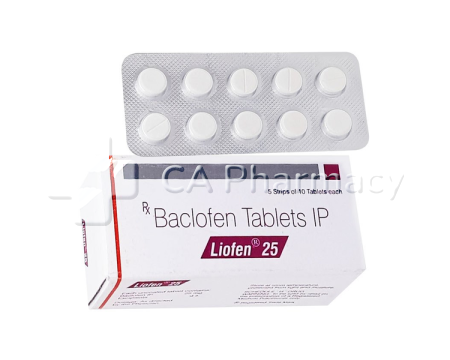

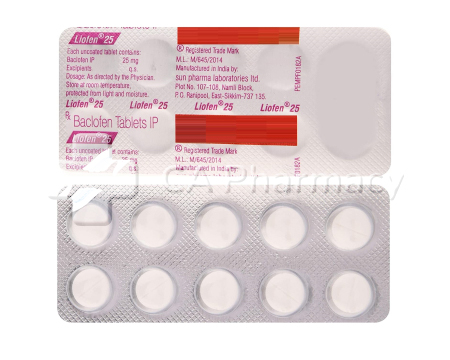


Baclofen 10mg & 20mg at a Glance
Mechanism of Action — GABA-B Agonism and Spinal Cord Pharmacology
Baclofen is a structural analogue of GABA (gamma-aminobutyric acid) with a specific molecular architecture — a phenyl ring attached to a gamma-aminobutyric acid backbone — that gives it selective GABA-B receptor affinity. Understanding the mechanism explains both why baclofen works and why its pharmacokinetics create specific clinical risks:

Health Canada Dosing Protocol — The Canadian Titration Schedule
The following titration schedule is based directly on the Health Canada product monograph for baclofen tablets (Lioresal, ratio-Baclofen, pms-Baclofen). This is the standard Canadian prescribing guidance — not a general recommendation:
From Dr. Sarah Mitchell, RPh: The most common prescribing error I see in Canadian clinical practice is rushing the titration — increasing doses too quickly because the patient is asking for faster relief. The 3-day minimum between increases exists for a clinical reason: baclofen accumulates over several days at each dose level, and CNS side effects (particularly sedation and cognitive effects) may not be fully apparent until day 2–3 at the new dose. Patients who experience significant drowsiness at any dose level should stay at that dose until it resolves — not increase further. The goal is optimal function, not maximum dose.
Renal Dose Adjustment — Critical for Canadian Patients with Kidney Disease
Baclofen's almost entirely renal elimination (70–85% unchanged) makes kidney function the single most important patient characteristic for safe dosing. The Health Canada product monograph has specific guidance:
| Renal function | GFR (eGFR) | Health Canada guidance | Maximum dose |
|---|---|---|---|
| Normal renal function | >60 mL/min | Standard titration protocol applies | 80mg/day |
| Mild–moderate impairment | 30–60 mL/min | Use with caution. Reduce starting dose. Monitor closely for excessive sedation and CNS effects. | Physician-determined reduced dose |
| Severe impairment | <30 mL/min | Health Canada: «use with special care and caution.» Significant accumulation risk. Monitor for toxic encephalopathy, drowsiness, impaired consciousness. | Specialist supervision required |
| Haemodialysis or peritoneal dialysis | Dialysis-dependent | Health Canada product monograph explicitly states: «a particularly low dose of baclofen should be selected — i.e., approximately 5mg daily.» Severe neurological outcomes including coma and death have been reported in dialysis patients given standard doses. | ~5mg/day |
Health Canada warning for elderly patients: Older Canadians are at significantly higher risk of baclofen toxicity for two reasons — age-related decline in renal function and increased CNS sensitivity. The Health Canada product monograph specifically states that «unwanted effects are more likely to occur in elderly patients» and recommends a «very cautious dosage schedule» with close monitoring for CNS depression, hallucinations, and toxic encephalopathy. Always have renal function (creatinine/eGFR) checked before starting baclofen in patients over 65.
Withdrawal Management and the Drug Holiday Protocol
Never Stop Baclofen Abruptly — Health Canada Black Box Warning
The Health Canada product monograph for baclofen (ratio-Baclofen product monograph, pdf.hres.ca) lists the following specific withdrawal symptoms upon abrupt discontinuation:
The Drug Holiday — When and How
A small percentage of patients (approximately 10%) develop tolerance to baclofen over time — requiring progressively higher doses for the same spasticity control. For these patients, a supervised "drug holiday" — a period of complete baclofen cessation under medical supervision — can restore sensitivity. Key clinical points:
- Drug holidays must only be conducted as an inpatient — the withdrawal risks require immediate medical supervision and emergency management capability
- Gradual withdrawal over 2–4 weeks minimum in hospital before the drug-free period
- Spasticity typically worsens significantly during the drug holiday — short-term alternative management (diazepam, physiotherapy) required
- After reintroduction, restart at the original starting dose (5mg three times daily) and retitrate
- Discuss with your neurologist or physiatrist whether a drug holiday is appropriate — do not attempt this outside a supervised clinical setting
Overdose Recognition — Signs, Symptoms, and Emergency Response
Baclofen overdose is a medical emergency. Early recognition is critical because CNS depression progresses rapidly at toxic doses:
Early signs — call doctor immediately
- Excessive drowsiness
- Dizziness and confusion
- Nausea and vomiting
- Muscle weakness beyond expected
- Hypotension (low blood pressure)
Severe — call 911 immediately
- Impaired or loss of consciousness
- Respiratory depression — slow, shallow breathing
- Coma
- Seizures
- Hallucinations and agitation
Emergency management
- Call 911 immediately
- Contact Poison Control Centre: 1-800-268-9017 (Ontario) or your provincial number
- For convulsions: diazepam IV may be used under medical supervision
- No specific antidote exists — supportive care in hospital
Generic Baclofen in Canada — Lioresal vs ratio-Baclofen vs pms-Baclofen
Multiple Health Canada–approved generic baclofen products are available in Canada. All contain the same active ingredient at the same dose and are therapeutically equivalent:
| Brand / Generic Name | Manufacturer | Strengths | Clinical equivalence |
|---|---|---|---|
| Lioresal | Novartis (original brand) | 10mg, 20mg | Reference product |
| ratio-Baclofen | Ratiopharm / Teva Canada | 10mg, 20mg | Bioequivalent — Health Canada approved |
| pms-Baclofen | Pharmascience | 10mg, 20mg | Bioequivalent — Health Canada approved |
| Baclofen (generic) | Various GMP-certified manufacturers | 10mg, 20mg | Same active ingredient, same dose — bioequivalent |

Side Effects
Very common — affecting most patients
- Drowsiness and sedation — most common; often improves after weeks
- Dizziness
- Muscle weakness (hypotonia) beyond spasticity reduction
- Fatigue
- Nausea — take with food
Common — report if troublesome
- Headache
- Confusion and cognitive effects
- Insomnia or sleep disturbance
- Urinary frequency or retention
- Dry mouth
- Constipation
- Hypotension — monitor blood pressure
Serious — seek immediate care
- Hallucinations — visual or auditory
- Seizures — particularly in patients with epilepsy history
- Toxic encephalopathy — impaired consciousness, coma (usually indicates accumulation in renal impairment)
- Respiratory depression — in overdose
Contraindications
- Hypersensitivity to baclofen or any excipient (10mg and 20mg tablets contain lactose — caution in lactose intolerance)
- Not approved for spasticity of rheumatic origin — baclofen is indicated for spasticity of neurological (central) origin only. It is not appropriate for musculoskeletal pain or rheumatic joint conditions
- Epilepsy — lower seizure threshold; use with close monitoring and appropriate antiepileptic co-medication
- Psychotic disorders, schizophrenia, confusional states — may worsen psychiatric symptoms
- Parkinson's disease — may exacerbate symptoms
- Renal dialysis — maximum ~5mg/day only
- Pregnancy — neonatal withdrawal reported; discuss with obstetrician
- Breastfeeding — passes into breast milk; monitor infant
- Children under 12 years — oral baclofen tablets not approved for this age group in Canada
Frequently Asked Questions — Baclofen in Canada
Can I take baclofen with food? Yes — baclofen can be taken with or without food. Taking it with food reduces nausea without significantly affecting absorption or efficacy. Food does not delay onset or reduce the antispasmodic effect. For patients who experience significant drowsiness, taking the larger portion of the daily dose at bedtime (while maintaining the 3–4 times daily schedule) can help manage daytime sedation.
What happens if I miss a dose? Take the missed dose as soon as you remember — unless it is almost time for the next scheduled dose. In that case, skip the missed dose and continue with your regular schedule. Never double up. Missing occasional doses does not cause immediate withdrawal in most patients, but missing multiple doses in a row (particularly at higher doses) can cause rebound spasticity and withdrawal symptoms.
Can I drink alcohol while taking baclofen? No — alcohol significantly amplifies baclofen's CNS depressant effects. Even one or two drinks can cause profound sedation, dizziness, and falls when combined with baclofen. The Health Canada product monograph notes that alcohol substantially increases CNS depression. This interaction is clinically significant at all dose levels.
How do I know if my dose needs to be adjusted? Signs the dose may be too high: excessive drowsiness during the day that does not improve after 1–2 weeks; muscle weakness that impairs walking or transfers; confusion or difficulty concentrating. Signs the dose may be too low: inadequate spasm reduction; muscle stiffness still significantly limiting physiotherapy participation; pain not adequately controlled. Discuss any of these with your prescribing physician before making dose changes.
Does baclofen affect my provincial drug coverage? Baclofen is listed on most Canadian provincial drug formularies for the approved indications. In Ontario it is covered under the Ontario Drug Benefit (ODB) plan for eligible recipients. In Quebec, it is covered under the RAMQ. Check with your provincial health plan and pharmacist for specific coverage details based on your province and eligibility.
Do I need a prescription for baclofen in Canada? Yes. Baclofen is a prescription-only medication in Canada. It must be prescribed by a licensed Canadian physician or nurse practitioner.
How long does delivery take to my province? Standard delivery to all Canadian provinces and territories takes 4–9 business days. All orders ship in neutral packaging with no external reference to the pharmacy name or medication type.
Related Category
- Muscle Relaxants Category — complete overview of baclofen therapy including GABA-B mechanism, oral vs intrathecal comparison, and the withdrawal warning
The content on this page is for educational purposes only and does not constitute medical or pharmacological advice. Baclofen is a prescription medication in Canada requiring a valid prescription from a licensed Canadian physician. Consult a licensed Canadian healthcare provider before starting, adjusting, or stopping baclofen therapy. Never stop baclofen abruptly — abrupt discontinuation can cause life-threatening withdrawal symptoms including seizures and hallucinations. For overdose emergencies, call 911 or your provincial Poison Control Centre immediately. Patients on renal dialysis must inform their prescribing physician — standard baclofen doses can cause fatal toxicity in dialysis-dependent patients.