
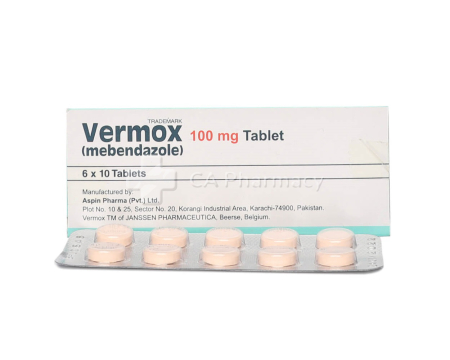
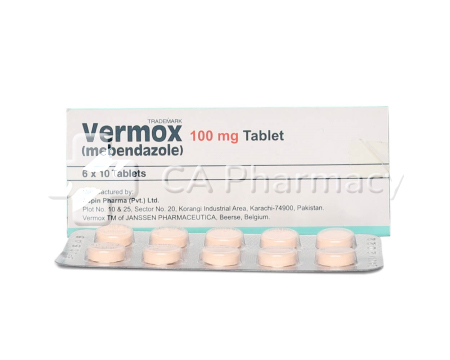


Important classification note: Mebendazole (Vermox) is an antiparasitic (anthelminthic) medication — not an antiviral, antibiotic, or antifungal. It has no activity against viruses, bacteria, or fungi. It treats only intestinal parasitic worm infections.

Vermox Generic at a Glance
How Mebendazole Works — Blocking Worm Tubulin to Cause Starvation and Death
Mebendazole's mechanism is entirely different from antibiotics, antivirals, and antifungals. It targets a structural protein unique to parasitic worm cells — and exploits the fact that mebendazole binds to worm tubulin far more tightly than to human tubulin:
From Dr. Sarah Mitchell, RPh: One of the most common patient questions is "why don't I feel different immediately after taking Vermox?" The answer is that mebendazole kills worms slowly — the first dose does not cause an instantaneous effect. Worms die and are expelled over several days. For pinworms specifically, the first dose eliminates adult worms but not the eggs they've already laid. The second dose at 2 weeks targets the next generation of worms that hatched from those eggs. Skipping follow-up doses almost always leads to recurrence.
Dosage by Parasite Type — Complete Reference (Health Canada / Vermox Product Monograph)
| Parasite / Infection | Dose | Schedule | Key notes |
|---|---|---|---|
| Pinworm (Enterobius vermicularis) Most common in Canadian children |
100mg (1 tablet) |
Single dose Repeat at Week 2 Repeat at Week 4 |
3 doses required. First dose kills adult worms. Weeks 2 and 4 doses kill newly hatched worms from eggs that survived the first dose. Treat all household members simultaneously regardless of symptoms. |
| Roundworm (Ascaris lumbricoides) | 100mg (1 tablet) |
Morning AND evening for 3 consecutive days |
200mg/day for 3 days. No fasting or special diet required. Tablets may be chewed or swallowed whole. |
| Whipworm (Trichuris trichiura) | 100mg (1 tablet) |
Morning AND evening for 3 consecutive days |
200mg/day for 3 days. If symptoms persist after 3 weeks, physician may prescribe a second course. |
| Hookworm (Ancylostoma, Necator) | 100mg (1 tablet) |
Morning AND evening for 3 consecutive days |
Hookworm can cause iron-deficiency anaemia. Physician may prescribe iron supplementation during and for 6 months after treatment. |
| Mixed infestation (multiple worm species) | 100mg (1 tablet) |
Morning AND evening for 3 consecutive days |
Mebendazole is effective against multiple species simultaneously in mixed infestations. Stool examination confirms clearance after treatment if needed. |
Age restriction: Not for children under 1 year. For children aged 1–6 who cannot swallow tablets, crush the tablet before administering. Always supervise young children during medication. Consult a physician for dosing in children under 2 years.
Pinworm Infection — The Household Treatment Protocol Explained
Pinworm (Enterobius vermicularis) is the most common worm infection in Canada, affecting primarily school-aged children. Understanding why household-wide treatment and hygiene measures are essential prevents treatment failure:
Who Needs Treatment — Even Without Symptoms
| Person in household | Has symptoms? | Needs treatment? | Reason |
|---|---|---|---|
| Child with itching / confirmed pinworm | Yes | Yes | Primary case — treat with full 3-dose protocol |
| Other children in the same household | Often none | Yes | High likelihood of asymptomatic carriage from shared bedroom, bathroom, and play surfaces |
| Parents / adults in the household | Usually none | Yes | Adults frequently carry pinworms asymptomatically. If untreated, they reinfect children even after successful child treatment. |
| Children under 1 year old | Any | Consult physician | Vermox is not approved for children under 1 year. A physician should assess and prescribe an appropriate alternative if treatment is required. |
From Dr. Sarah Mitchell, RPh: The single most common reason pinworm treatment fails is treating only the child who has symptoms. In the vast majority of cases I see clinically, another household member — usually a parent or sibling — is an asymptomatic carrier. Within weeks of completing treatment, the child is reinfected. Simultaneous household treatment on the same day, combined with bedding laundering and handwashing protocol, is the only approach that reliably clears the infection.
What Vermox Treats — and What It Cannot
Side Effects
Mebendazole has an excellent safety profile at standard doses due to its very low systemic absorption (<10%). Side effects are almost entirely limited to the gastrointestinal tract:
Common (with heavy worm burden)
- Abdominal pain or cramping
- Diarrhoea
- Nausea and vomiting
- Flatulence
Usually mild and transient. More common in patients with heavy worm burdens as dying worms are expelled.
Rare — report to doctor
- Elevated liver enzymes (with prolonged high-dose therapy)
- Neutropenia (low white blood cell count — rare, long-term high doses)
- Hair loss — rare, associated with prolonged therapy
- Skin rash or urticaria
Serious — seek immediate care
- Stevens-Johnson syndrome — if also taking metronidazole (Flagyl). Never combine Vermox with metronidazole.
- Severe allergic reaction — rash, facial swelling, difficulty breathing
- Agranulocytosis — very rare; sudden fever with extreme weakness
Contraindications and Precautions
- Hypersensitivity to mebendazole or any ingredient in the tablet
- Children under 1 year — not approved; safety not established
- Pregnancy — generally avoided, particularly in the first trimester. Animal studies show teratogenicity. Use only if clearly needed; discuss with your physician or midwife.
- Metronidazole (Flagyl) — avoid combination. The combination of mebendazole and metronidazole carries significant risk of Stevens-Johnson syndrome and toxic epidermal necrolysis — severe and potentially fatal skin reactions.
- Liver disease — mebendazole is extensively metabolised by the liver. Use with caution in severe hepatic impairment.
- Inflammatory bowel disease (Crohn's disease, ulcerative colitis) — discuss with your physician; intestinal conditions may affect drug behaviour and tolerability
Drug Interactions
- Metronidazole — absolute: avoid combination. Risk of Stevens-Johnson syndrome and toxic epidermal necrolysis. This interaction is listed as a serious drug-drug interaction in the Health Canada product monograph for Vermox.
- Carbamazepine (epilepsy) — reduces mebendazole blood levels by inducing its hepatic metabolism. May reduce efficacy; your physician may adjust the dose.
- Phenytoin (epilepsy) — similarly reduces mebendazole levels through enzyme induction. Discuss with your physician if you are on phenytoin.
- Cimetidine — may increase mebendazole levels by inhibiting hepatic metabolism. Generally not clinically significant at standard doses.
- High-fat meal — increases mebendazole bioavailability modestly. For intestinal worm infections, this is generally not a concern — and the product does not need to be taken with food.
Frequently Asked Questions — Vermox Generic in Canada
Do I need a prescription for Vermox in Canada? For pinworm infections, mebendazole 100mg is generally available without a prescription at most Canadian pharmacies. For other worm infections (roundworm, hookworm, whipworm), a physician's assessment and prescription is typically recommended to confirm the diagnosis and rule out complications. Check with your pharmacist about current availability in your province.
Can I take Vermox with food? Yes — mebendazole can be taken with or without food. No special diet, fasting, or laxatives are required before, during, or after treatment. For children who have difficulty swallowing tablets, crush the tablet and mix it into a small amount of food.
How do I know if the treatment worked? For pinworms, the key sign of successful treatment is resolution of nocturnal anal itching within 1–2 weeks of the first dose. For heavier worm infestations (roundworm, hookworm), your physician may request a follow-up stool examination 3–4 weeks after the treatment course to confirm clearance. If symptoms return or persist after the complete 3-dose pinworm regimen, consult your physician — reinfection from the environment or an untreated household member is the most common reason for treatment failure.
Is it normal to see worms in the stool after taking Vermox? Yes — this is expected and indicates the treatment is working. Dying and dead worms are expelled in the faeces over the 1–3 days following treatment. Some patients see worms, others do not (depending on worm burden and type). Either outcome is normal.
Can Vermox be used for tapeworm infections? Vermox is not the standard treatment for most tapeworm infections. Mebendazole has very limited activity against tapeworm species (Taenia) and no evidence of efficacy against cysticercosis. Tapeworm infections require different antiparasitic agents (praziquantel or albendazole). Consult your physician for diagnosis and appropriate treatment if you suspect a tapeworm infection.
How long does delivery take to my province? Standard delivery to all Canadian provinces and territories takes 4–9 business days. All orders ship in neutral packaging with no external reference to the pharmacy name or medication type.
Related Products and Category
- Anti-Viral & Antiparasitic Category — overview of all three products in this category with classification notes
The content on this page is for educational purposes only and does not constitute medical or pharmacological advice. For pinworm infections, mebendazole 100mg is generally available without prescription at Canadian pharmacies; for other worm infections, consult a licensed Canadian healthcare provider for diagnosis and appropriate treatment. If symptoms persist after completing the full treatment regimen, seek medical assessment — persistent symptoms may indicate reinfection, treatment failure, or a different type of infection requiring alternative management.