
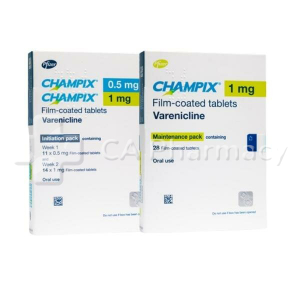
Stop Smoking Medication
Medically reviewed by Dr. Sarah Mitchell, RPh, Clinical Pharmacist — Updated April 2026
Prescription smoking cessation medications represent the most effective pharmacological tools available to help Canadians quit tobacco — dramatically improving quit rates compared to willpower alone or nicotine replacement therapy (NRT). Tobacco use remains the leading preventable cause of premature death in Canada, responsible for approximately 48,000 Canadian deaths annually and costing the Canadian healthcare system an estimated $16 billion each year in direct and indirect costs. Despite this, approximately 13% of Canadians aged 15 and older — roughly 4 million people — continue to smoke daily or occasionally, with the majority having made multiple unsuccessful quit attempts. The science of smoking cessation is clear: pharmacotherapy combined with behavioural counselling produces the highest quit rates of any cessation approach. At drugs-canada.com, we offer Champix (Varenicline) — the single most effective pharmacological smoking cessation treatment available in Canada, with demonstrated quit rates approximately 3 times higher than placebo and approximately 1.5 to 2 times higher than nicotine replacement therapy at 12 months. From $6.27 per pill — with discreet delivery to all Canadian provinces and territories in 4 to 9 business days.
Our Stop Smoking Product
| Product | Active Ingredient | Drug Class | Mechanism | Quit Rate vs Placebo | From |
|---|---|---|---|---|---|
| Champix | Varenicline tartrate | Partial nicotinic acetylcholine receptor agonist | Blocks nicotine binding + partial dopamine release to reduce cravings and withdrawal | ~3× higher | $6.27/pill |
Champix (Varenicline) — How It Works
Champix (Varenicline) is a partial agonist at the alpha-4 beta-2 (α4β2) subtype of the nicotinic acetylcholine receptor (nAChR) — the receptor subtype most responsible for nicotine's addictive effects in the brain. This dual mechanism sets varenicline apart from every other smoking cessation medication:
Understanding nicotine addiction — the neurobiological basis: Nicotine produces its pleasurable and addictive effects primarily by binding to α4β2 nicotinic acetylcholine receptors in the ventral tegmental area (VTA) of the brain, triggering the release of dopamine into the nucleus accumbens — the brain's reward centre. This dopamine release produces pleasure, reinforces smoking behaviour, and over time creates the powerful conditioning and craving cycle that makes tobacco addiction so difficult to break. When a smoker goes without nicotine, dopamine levels fall, producing the uncomfortable withdrawal symptoms — irritability, anxiety, difficulty concentrating, restlessness, increased appetite, and craving — that drive relapse.
Varenicline's two-pronged mechanism:
- Partial agonism — reducing cravings and withdrawal: Varenicline binds to α4β2 nAChRs and partially activates them — stimulating enough dopamine release to reduce the severity of nicotine withdrawal symptoms and cravings without producing the full euphoric effect of nicotine. This partial activation keeps the brain's dopamine system partially satisfied during smoking cessation, reducing the urgency and intensity of cravings
- Competitive antagonism — blocking nicotine's reward: Because varenicline occupies the α4β2 receptor, it blocks nicotine molecules from binding when a patient smokes. This blocking effect substantially reduces or eliminates the pleasurable dopamine surge normally associated with smoking — removing the reward that reinforces the habit. Patients who smoke while taking varenicline typically find it much less satisfying than before, which further reduces the motivation to continue smoking
The combined result: Withdrawal is less severe (partial agonism provides dopamine support) AND smoking is less rewarding (antagonism blocks nicotine's dopamine effect) — creating the ideal pharmacological environment for successful cessation.
Champix vs Other Cessation Methods — The Canadian Comparison
Canadian smokers have multiple cessation options. Champix's position in the evidence hierarchy is clear:
| Method | 12-Month Continuous Abstinence Rate | vs Placebo (OR) | Canadian Availability | Key Advantages | Key Limitations |
|---|---|---|---|---|---|
| Champix (Varenicline) | ~22–26% | ~3.1× (most effective) | Prescription — physician/NP | Most effective single medication; dual mechanism; no nicotine | Prescription required; nausea common initially; psychiatric monitoring recommended |
| Zyban (Bupropion) | ~18–20% | ~2.0× | Prescription (generic available) | Also treats depression/ADHD; good for smokers with depression | Lowers seizure threshold; more drug interactions |
| Nicotine Patch (NRT) | ~16–18% | ~1.9× | OTC at all Canadian pharmacies | No prescription needed; widely available; combination NRT effective | Nicotine still delivered; lower efficacy than varenicline |
| Nicotine Gum/Lozenge (NRT) | ~15–17% | ~1.8× | OTC at all Canadian pharmacies | Flexible dosing; good for breakthrough cravings | Correct technique required; lower efficacy than varenicline |
| Combination NRT (patch + gum) | ~20–22% | ~2.5× | OTC | More effective than single NRT; no prescription needed | More complex regimen; still delivers nicotine |
| Willpower alone (cold turkey) | ~3–7% | 1.0× (reference) | — | No cost; no side effects | Very low success rate; high relapse risk |
| Champix + Behavioural Counselling | ~30–35% | Highest | Prescription + counselling programs | Best results of any combination | Requires additional commitment to counselling |
Key Canadian clinical guideline recommendation (CTFPHC and CDA): Varenicline (Champix) is recommended as first-line pharmacotherapy for smoking cessation in all adult Canadian smokers motivated to quit, with a strong Grade A recommendation. Combination of varenicline with behavioural counselling (QuitNow! program, phone counselling, CBT-based cessation programs) produces the highest quit rates available in Canadian clinical practice.
Canadian Dosing Protocol — Standard and Flexible Start
Health Canada has approved two starting approaches for Champix:
Standard Fixed Start (most common in Canadian practice):
- Days 1–3: 0.5mg once daily
- Days 4–7: 0.5mg twice daily
- Day 8 onwards (continuing through week 12): 1mg twice daily (standard maintenance dose)
- Set a quit date for Day 8 — when the 1mg twice daily dose begins
- Total standard course: 12 weeks (84 days)
- For patients who successfully quit at 12 weeks: an additional 12-week course (total 24 weeks) is recommended by Health Canada to further reduce relapse risk — long-term abstinence rates at 12 months are significantly higher with 24 vs 12 weeks of treatment
Flexible Start (alternative approach):
- Begin the same titration (Days 1–3: 0.5mg daily; Days 4–7: 0.5mg twice daily; Day 8+: 1mg twice daily)
- Set quit date anywhere between Day 8 and Day 35 (up to 5 weeks after starting medication)
- This approach allows patients who are not ready to set an immediate quit date to start medication while they prepare mentally and reduce cigarette consumption before quitting entirely
- Evidence shows the flexible start produces comparable quit rates to the standard fixed start — giving Canadian patients and physicians more choice in how to approach quitting
Dosage adjustment for renal impairment: In Canadian patients with severe renal impairment (eGFR <30 mL/min/1.73m²), the maximum dose is 1mg once daily (not twice daily). Champix is renally excreted — dose adjustment is essential for patients with significant kidney disease to avoid drug accumulation.
Taking Champix: Always take with food and a full glass of water to reduce nausea — the most common side effect. If nausea persists at 1mg twice daily, reduce temporarily to 0.5mg twice daily and reattempt dose escalation after 1–2 weeks. Never take on an empty stomach.
Smoking Cessation in Canada — Provincial Programs and Coverage
An important advantage for Canadian smokers: several provincial and territorial health programs provide partial or full coverage for Champix (varenicline) — significantly reducing out-of-pocket costs:
- Ontario: Ontario Drug Benefit (ODB) covers varenicline for eligible patients (Ontario Works, ODSP recipients, seniors on GIS). The Smoking Cessation Program through Ontario's Stop-Smoking Services also provides free behavioural counselling
- British Columbia: BC PharmaCare Plan W (Smoking Cessation Program) provides funding for one course of cessation medications per year (including varenicline) for BC residents — available to all BC residents with a valid BC Services Card, regardless of income. This is one of the most generous provincial cessation coverage programs in Canada
- Quebec: RAMQ (Régie de l'assurance maladie du Québec) covers varenicline for RAMQ-insured individuals. Quebec's J'Arrête program provides integrated pharmacotherapy and counselling
- Alberta: The Alberta Aids to Daily Living and specific benefit programs cover varenicline for eligible recipients. AHS Tobacco Reduction programs provide counselling support
- Manitoba: Manitoba Pharmacare covers varenicline under the provincial drug benefit program for eligible Manitoba residents
- Saskatchewan: Saskatchewan Drug Plan covers varenicline for registered Saskatchewan residents
- Nova Scotia, New Brunswick, PEI, Newfoundland: Provincial drug benefit programs cover varenicline for eligible residents — check with your provincial health authority for current coverage details
- Private insurance: Most Canadian employer-sponsored extended health benefit plans cover prescription smoking cessation medications including Champix — check your benefits booklet or contact your benefits administrator
Even without provincial coverage, Champix generic (varenicline) from drugs-canada.com at $6.27/pill represents substantial cost savings compared to the ongoing cost of cigarettes — a pack-a-day Canadian smoker spending $15–18/day on cigarettes spends $450–540/month, compared to the cost of a 12-week Champix course.
Side Effects — Complete Canadian Guide
Very common — affecting >10% of patients:
- Nausea — the most prevalent side effect: Affects approximately 28–30% of patients — most pronounced in the first 2 to 4 weeks and usually improves significantly as the body acclimatises. Almost entirely preventable by taking Champix with food and a full glass of water. If nausea is severe at 1mg twice daily, reduce to 0.5mg twice daily and increase again after 1 to 2 weeks. Most patients who experience early nausea find it significantly diminishes after the first month
- Abnormal/vivid dreams and insomnia: Varenicline commonly causes intensely vivid dreams — often described as "more real" than normal dreams. If disruptive to sleep, taking the evening dose earlier (with dinner rather than before bed) can help. Some patients experience insomnia — dose timing adjustment is the first intervention
- Headache: Common in the first 2 to 4 weeks; usually resolves
Common — affecting 1–10% of patients:
- Constipation or flatulence — usually mild; increased fluid and fibre intake helps
- Dry mouth — stay well hydrated
- Dizziness — avoid activities requiring full alertness until the effect is assessed; usually mild and resolves
- Increased appetite and weight gain — a normal consequence of nicotine cessation; not unique to varenicline. Nicotine increases metabolic rate and suppresses appetite — cessation of smoking typically produces 4–5 kg weight gain on average regardless of which cessation method is used. Regular physical activity and dietary mindfulness help manage cessation-related weight gain
- Skin reactions — rash, pruritus; rare serious cutaneous reactions (Stevens-Johnson syndrome) have been reported — stop varenicline and seek medical attention if severe skin reaction develops
Neuropsychiatric effects — Health Canada guidance (updated 2016):
Health Canada removed the black box warning for neuropsychiatric adverse effects from Champix in 2016 following the results of the landmark EAGLES trial (Anthenelli et al., Lancet 2016) — a large, randomised, double-blind study of over 8,000 smokers specifically designed to evaluate neuropsychiatric safety. The EAGLES trial found that varenicline did not significantly increase the risk of neuropsychiatric adverse events — including suicidal ideation, depression, anxiety, or aggression — compared to nicotine patch, bupropion, or placebo in both psychiatric and non-psychiatric patient populations.
Current Health Canada guidance acknowledges that: (1) some patients may experience mood changes, anxiety, or sleep disturbance while taking Champix; (2) nicotine withdrawal itself causes mood and anxiety symptoms that can be mistaken for medication side effects; (3) patients with pre-existing psychiatric conditions should be monitored for any significant mood changes during treatment; (4) patients experiencing suicidal thoughts during treatment should stop Champix and contact their physician immediately or call 9-8-8.
Cardiovascular safety — the EAGLES trial and post-marketing evidence: The EAGLES trial demonstrated no increased risk of major adverse cardiovascular events (MACE) with varenicline compared to placebo in smokers with and without established cardiovascular disease. Subsequent meta-analyses have confirmed varenicline's cardiovascular safety profile. Champix is safe to use in the vast majority of Canadian patients with cardiovascular disease — and quitting smoking produces immediate and substantial cardiovascular benefit that greatly outweighs any theoretical risk from the medication.
Smoking and Health — The Canadian Context
Tobacco use causes or contributes to the leading causes of preventable death in Canada — lung cancer, COPD, cardiovascular disease, and stroke. Key Canadian statistics from the Public Health Agency of Canada:
- Approximately 48,000 Canadians die prematurely from tobacco-related diseases each year
- Tobacco is the leading cause of preventable death in Canada — responsible for approximately 30% of all cancer deaths
- 13.3% of Canadians aged 15+ reported current smoking in the most recent Canadian Community Health Survey
- Approximately 70% of Canadian smokers say they want to quit — but fewer than 5% succeed in any given year without pharmacological support
- The average Canadian smoker makes 8 to 11 quit attempts before achieving sustained abstinence — pharmacotherapy significantly increases the probability of success with each attempt
The benefits of quitting — what Canadian smokers gain:
- 20 minutes: Heart rate and blood pressure drop toward normal
- 12 hours: Carbon monoxide levels in blood normalise; oxygen-carrying capacity improves
- 2 weeks to 3 months: Circulation improves; lung function begins to improve; exercise tolerance increases
- 1 to 9 months: Coughing and shortness of breath decrease; cilia in lungs begin to regrow and function; energy levels increase
- 1 year: Risk of coronary heart disease is half that of a continuing smoker
- 5 years: Risk of stroke is reduced to that of a non-smoker; lung cancer risk halved compared to continued smoking
- 10 years: Lung cancer death rate comparable to non-smoker; risk of cancers of mouth, throat, oesophagus, bladder, kidney, and pancreas decreased
- 15 years: Risk of coronary heart disease comparable to non-smoker
Canadian Smoking Cessation Resources
- QuitNow! (BC): quitnow.ca — free telephone and online cessation coaching available to all BC residents
- Smokers' Helpline (Ontario, national): 1-877-513-5333 — free counselling, text support, and online community; operated by the Canadian Cancer Society
- J'Arrête (Quebec): jarrete.qc.ca — free cessation program with integrated pharmacotherapy and coaching
- Canada's Tobacco and Vaping Page (Health Canada): canada.ca/en/health-canada/services/smoking-tobacco — official cessation resources and quit tools
- Canadian Cancer Society: cancer.ca — smoking cessation information and provincial resources
- Telehealth cessation support: Maple, Tia Health, and other Canadian telehealth platforms provide virtual physician consultations that can initiate Champix prescriptions and provide ongoing cessation counselling
Delivery to All Canadian Provinces and Territories
drugs-canada.com ships Champix discreetly to all Canadian provinces and territories. Standard delivery: 4–9 business days.
Ontario (Toronto, Ottawa, Hamilton, London, Brampton, Mississauga, Kitchener-Waterloo) — Quebec (Montreal, Quebec City, Laval, Gatineau, Sherbrooke) — British Columbia (Vancouver, Surrey, Burnaby, Victoria, Kelowna, Abbotsford) — Alberta (Calgary, Edmonton, Red Deer, Lethbridge) — Manitoba (Winnipeg, Brandon) — Saskatchewan (Saskatoon, Regina) — Nova Scotia (Halifax, Sydney) — New Brunswick (Moncton, Saint John, Fredericton) — Newfoundland and Labrador (St. John's, Corner Brook) — Prince Edward Island (Charlottetown) — Northwest Territories (Yellowknife) — Yukon (Whitehorse) — Nunavut (Iqaluit).
All orders are dispatched in plain, unmarked packaging with no reference to the contents or sender. Every order includes a tracking number.
Frequently Asked Questions — Stop Smoking Medication in Canada
Is Champix (varenicline) covered in Canada? Coverage depends on your province and insurance plan. British Columbia offers the most accessible coverage — BC PharmaCare Plan W covers one cessation medication course per year for all BC residents regardless of income. Ontario, Quebec, Alberta, Manitoba, and Saskatchewan all have provincial drug benefit programs that cover varenicline for eligible residents. Most employer-sponsored extended health benefit plans in Canada cover prescription smoking cessation medications. Check your provincial health ministry website or your benefits plan documents for current coverage details. Even without coverage, the cost of Champix is lower than the ongoing cost of cigarettes for most Canadian smokers.
How long do I need to take Champix? The standard Health Canada-approved course is 12 weeks. For patients who successfully quit at 12 weeks, an additional 12-week course (total 24 weeks) is strongly recommended — evidence from clinical trials shows that 24-week courses produce significantly higher 12-month abstinence rates than 12-week courses. For Canadian patients who are motivated but have not achieved abstinence after 12 weeks, a physician can assess whether an extended course or combination with counselling is appropriate.
Can I smoke at all while taking Champix? During the first week (dose titration), most patients continue to smoke normally. From the quit date (Day 8 with standard start, or the chosen quit date within Days 8–35 with flexible start), the goal is complete abstinence. If you smoke while on the maintenance dose, varenicline's blocking effect means the cigarette will produce much less satisfaction than usual — this is often a useful deterrent. Some patients reduce gradually rather than stopping completely at the quit date; while complete abstinence produces better outcomes, gradual reduction while on Champix is still far better than unassisted reduction attempts.
Is Champix safe if I have heart disease? Yes — the EAGLES trial specifically examined cardiovascular safety and found no increased risk of major adverse cardiovascular events with varenicline compared to placebo in smokers with and without established cardiovascular disease. Furthermore, quitting smoking produces immediate cardiovascular benefits (blood pressure reduction, improved oxygenation, reduction in inflammatory markers) that substantially reduce cardiovascular risk — benefits that far outweigh any theoretical medication risk. Discuss your cardiac history with your Canadian physician when considering Champix.
What should I do if I relapse while on Champix? A relapse or slip does not mean treatment failure — it is a normal part of the cessation process for most smokers. If you smoke while on Champix, continue the medication, note what triggered the relapse, and recommit to your quit date. Canadian cessation guidelines recommend treating a slip as information rather than failure — what triggered it, how can it be avoided next time. If you have completed a course and relapsed after stopping Champix, another course can be prescribed — studies show repeated courses are effective for patients who relapsed after a successful initial course.
How long does delivery to Canada take? Standard delivery to all Canadian provinces and territories takes 4 to 9 business days. All orders arrive in plain, unmarked packaging with no reference to the contents or sender. Every order includes a tracking number.
All information on this page is for general informational purposes only and does not constitute medical advice. Champix (varenicline) is a Schedule F prescription medicine in Canada — a valid prescription from a licensed Canadian healthcare provider is required. Always consult a qualified Canadian physician, nurse practitioner, or pharmacist before starting smoking cessation treatment. Smoking cessation combined with behavioural counselling produces the best results — take advantage of free Canadian cessation support programs.